
A pull-tight seal (also called an adjustable or pull-up seal) is a single-use plastic seal with a tail that passes through the closure and back into its own locking head. You pull it to the loop size you need, and it cannot be loosened without breaking it. That adjustability is why one model can cover bags, totes, trolleys and cabinet handles. It is also why choosing only by overall length often goes wrong.
What is a pull-tight seal, and how is it different from a fixed-length seal?
- Pull-tight: the tail locks at any point along its length, so the loop is adjustable. Examples: MC-250B, MC-KTPS, MC-JY418D.
- Fixed-length: the tail locks at one defined point, so every installed loop is the same size and easy to compare at inspection. See fixed-length seals.
Choose pull-tight when your closures vary in size or you want one model for several uses. Choose fixed-length when a consistent loop matters more than flexibility.

What length of pull-tight seal do you need?
Overall length is not the same as usable loop. The flag and locking head are part of the overall length, and the end of the tail must pass through the head to lock. So:
- Measure the path the seal must travel through the closure points, plus any slack your inspection process needs.
- Add enough tail to pass fully through the locking head.
- Pick a model whose overall length clearly exceeds that total, then confirm it on a sample.
Our plastic seals are grouped by overall length: 0–199 mm, 200–299 mm, 300–399 mm, 400–499 mm and 500 mm and longer. For a step-by-step measuring method, read how to choose a plastic seal length.
Should the lock be all-plastic or have a metal clip?
This is the main design choice after length.
| Feature | All-plastic lock | Metal locking clip | Double metal clip |
|---|---|---|---|
| How it locks | Beads or teeth on the tail pass one way through a moulded plastic lock | A metal clip inside the plastic head grips the tail | Two metal clips in series grip the tail at two points |
| Typical uses | Bags, totes, garment and retail tags, light closures | Courier bags, logistics totes, roll cages, trolleys, container door handles | Closures where you want a backup grip on the tail |
| Recycling | Single material (polypropylene), easier to recycle | Plastic and metal parts | Plastic and metal parts |
| Example models | MC-170B, MC-210T, MC-250B | MC-JY166, MC-KTPS, MC-ERPS, MC-R5 | MC-JY418D |
A metal clip changes how the lock grips; it does not by itself make a seal "high security". If your shipment needs a tested or certified rating, ask for documentation for the exact model before you specify it.

Hand-tear or cut: how will the seal be removed?
Think about the person who opens the seal, not only the person who fits it.
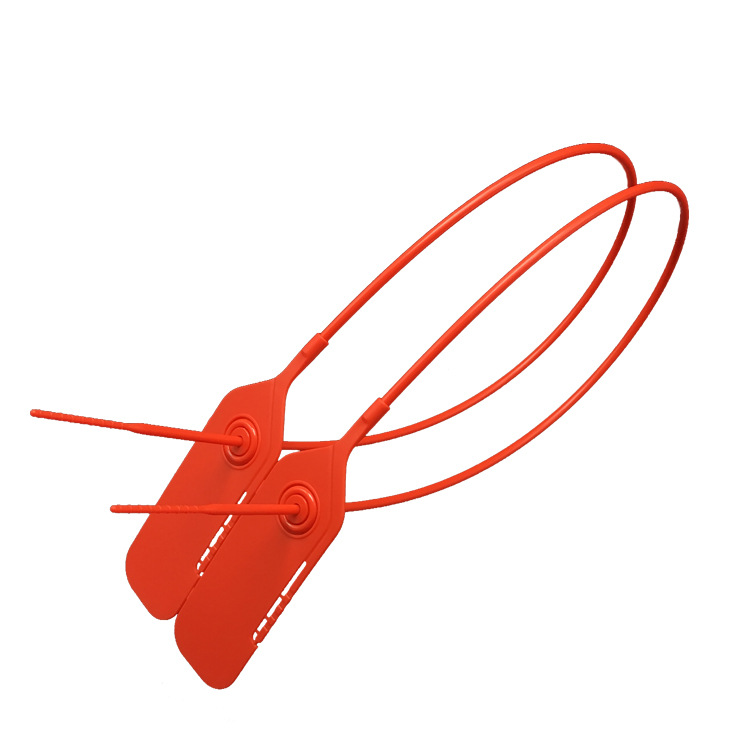
- Hand-tear models have a built-in tear point, so staff can open them without a cutter. This speeds up handling where many seals are opened every day, such as catering trolleys and returnable totes. Examples: MC-210T, MC-230JY, MC-JY166 and the 550 mm MC-R5.
- Cut-to-remove models need scissors or a cutter, which keeps removal a deliberate step. Examples: MC-KTPS, MC-JY418D.
Either way the seal is single-use: once it is torn or cut, it cannot be refitted, and a missing or broken seal shows that the closure was opened.
Which tail size fits your closure?
The tail must pass through the smallest hole in the closure. Check the tail size on the dimension drawing:
- Thin tails (about 1.4–2 mm, e.g. MC-170B, MC-JY166) suit zipper pulls, small eyelets and garment tags.
- Medium tails (2.5–2.6 mm, e.g. MC-KTPS, MC-250B) suit most courier bags, totes and trolley latches.
- Thicker round tails (3.3 mm on MC-R5) slide easily through handles and netting on larger closures.
Beaded and round tails pass smoothly through round holes; flat toothed or ribbed straps suit slot-shaped openings. When in doubt, send a photo of the closure with the hole measured.
How much space do you need for logo, numbers and barcode?
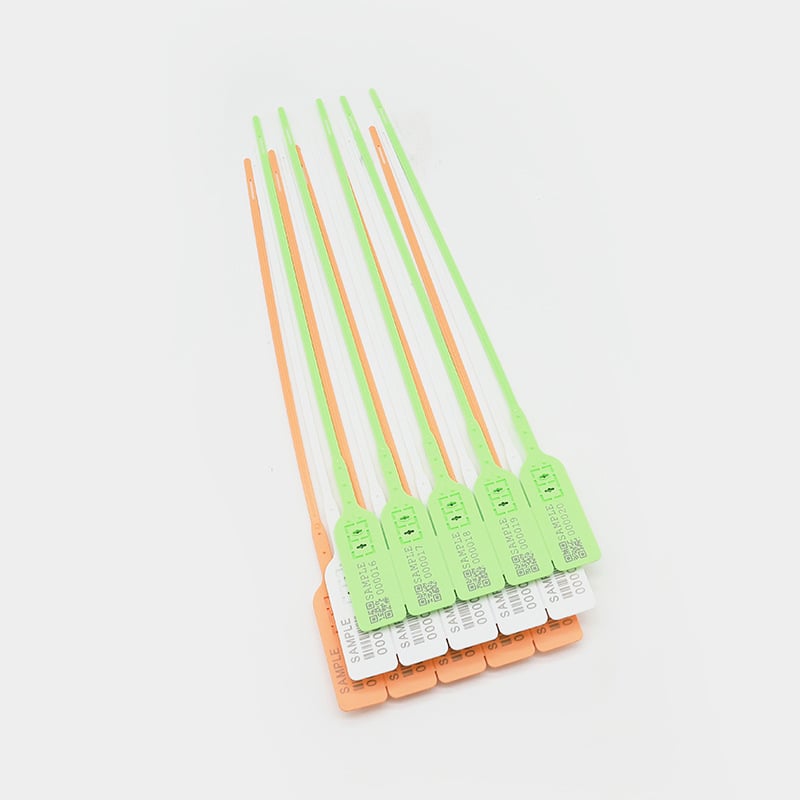
The flag carries the marking, so its size limits what you can print. Plastic flags can be laser marked, screen printed, UV printed or hot stamped. The process, layout and readability are confirmed on a production sample against your artwork and serial format.

- A small flag (27 × 18 mm on MC-JY166) fits a short logo and a serial number.
- A medium flag (40 × 20 mm on MC-250B, 37 × 20 mm on MC-KTPS) fits a logo, a serial number and a short barcode.
- A large flag (46 × 29 mm on MC-JY418D, 58 × 30 mm on MC-R5) leaves room for a logo, text, serial number and barcode.
For numbering rules (prefix, digits, sequence ranges and barcode format), use our security seal numbering checklist.
Example models at a glance
| Model | Overall length | Tail | Flag | Lock | Removal | Catalogue MOQ |
|---|---|---|---|---|---|---|
| MC-JY166 | 166 mm | 2 mm | 27 × 18 mm | Metal clip | Hand-tear | 1,000 pcs |
| MC-210T | 208 mm | Beaded | 42.5 × 18 mm | All-plastic | Hand-tear | 1,000 pcs |
| MC-250B | 250 mm | 2.6 mm beaded | 40 × 20 mm | All-plastic | Not specified – confirm on sample | 500 pcs |
| MC-KTPS | 200, 300 or 370 mm | 2.5 mm round | 37 × 20 mm | Metal clip | Cut | 1,000 pcs |
| MC-JY418D | 418 mm | See drawing | 46 × 29 mm | Two metal clips | Scissors or cutter | 1,000 pcs |
| MC-R5 | 550 mm | 3.3 mm round | 58 × 30 mm | Metal clip | Hand-tear | 5,000 pcs |
See every adjustable model on the pull-tight seals page, or browse all plastic security seals.
What should you send your supplier before ordering?
- A photo of the closure, the smallest hole size and the loop path you measured.
- Your removal preference: hand-tear or cut.
- Colour, logo, text, serial number format and any barcode.
- Quantity per order and per year, and the delivery country.
If you are still deciding between plastic and cable formats, read plastic vs cable seals. For heavier doors, compare bolt, cable and padlock seals.
Frequently asked questions
What is the difference between a pull-tight seal and a fixed-length seal?
A pull-tight seal locks at any point along its tail, so you can adjust the loop to the closure. A fixed-length seal locks at one set point, so every loop is the same size. Pull-tight suits mixed closures; fixed-length suits inspections that compare loop size.
Can a plastic pull-tight seal be reused?
No. It is single-use. Once it is locked, it can only be opened by tearing it at the release point (on hand-tear models) or cutting it, and it cannot be refitted.
Do I need a metal locking clip?
Not always. All-plastic locks suit light closures and are easier to recycle. A metal clip grips the tail more firmly, and a double clip adds a second grip point. Choose based on the closure and handling, and ask for model-specific documentation if you need a tested rating.
Can I open a pull-tight seal without tools?
Yes, if you choose a hand-tear model such as MC-210T, MC-230JY, MC-JY166 or MC-R5. Other models need scissors or a cutter.
How long should the seal be?
Longer than the loop path plus the tail needed to pass through the locking head. Overall length includes the flag and head, so do not compare overall length directly with your loop. Confirm the fit on a sample.
What can be printed on the flag?
A logo or company name, text, sequential serial numbers and barcodes, depending on flag size. Plastic flags can be laser marked, screen printed, UV printed or hot stamped; the process is confirmed on a production sample.
What is the minimum order quantity?
It depends on the model. Catalogue examples: MC-250B 500 pieces; MC-JY166, MC-210T, MC-KTPS and MC-JY418D 1,000 pieces; MC-R5 5,000 pieces.
Ready to choose?
Send a photo of your closure, the hole size, your removal preference and the quantity through our quote form. We will recommend a pull-tight model and confirm marking options in the quotation.
Compare seal types →