
A cable seal is a single-use seal made of braided steel wire rope and a locking body. It suits closures where a rigid bolt does not fit: offset hasps, handles, valves and doors whose holes are small or do not line up. Like every security seal, it is tamper-evident – removing it means cutting the cable – so the right size and a clear serial number matter more than the heaviest cable you can find.
What cable diameter do you need?
Start with the smallest opening the cable must pass through, then choose the thickest cable that still passes easily.
| Cable diameter | Typical closures | Example models |
|---|---|---|
| 1.0–1.5 mm | Cash and document bags, cabinets, meters, small hasps and eyelets | MC-CF (1.0–2.5 mm), MC-NCF (from 1.5 mm) |
| 1.8–2.5 mm | Truck doors, container door handles, bank and logistics doors | MC-K, MC-K2, MC-NK2 (1.8 mm); MC-CF, MC-NCF |
| 3.0–5.0 mm | Heavier closures where a thicker cable is preferred | MC-CFB (3.0–5.0 mm), MC-NCF (up to 5.0 mm) |
Thicker cable takes more effort to cut and needs a heavier cutter to remove – MC-CFB is removed with a heavy-duty cable cutter. It is still a tamper-evident seal, so do not choose a diameter that will not pass the hole just to make it "stronger".
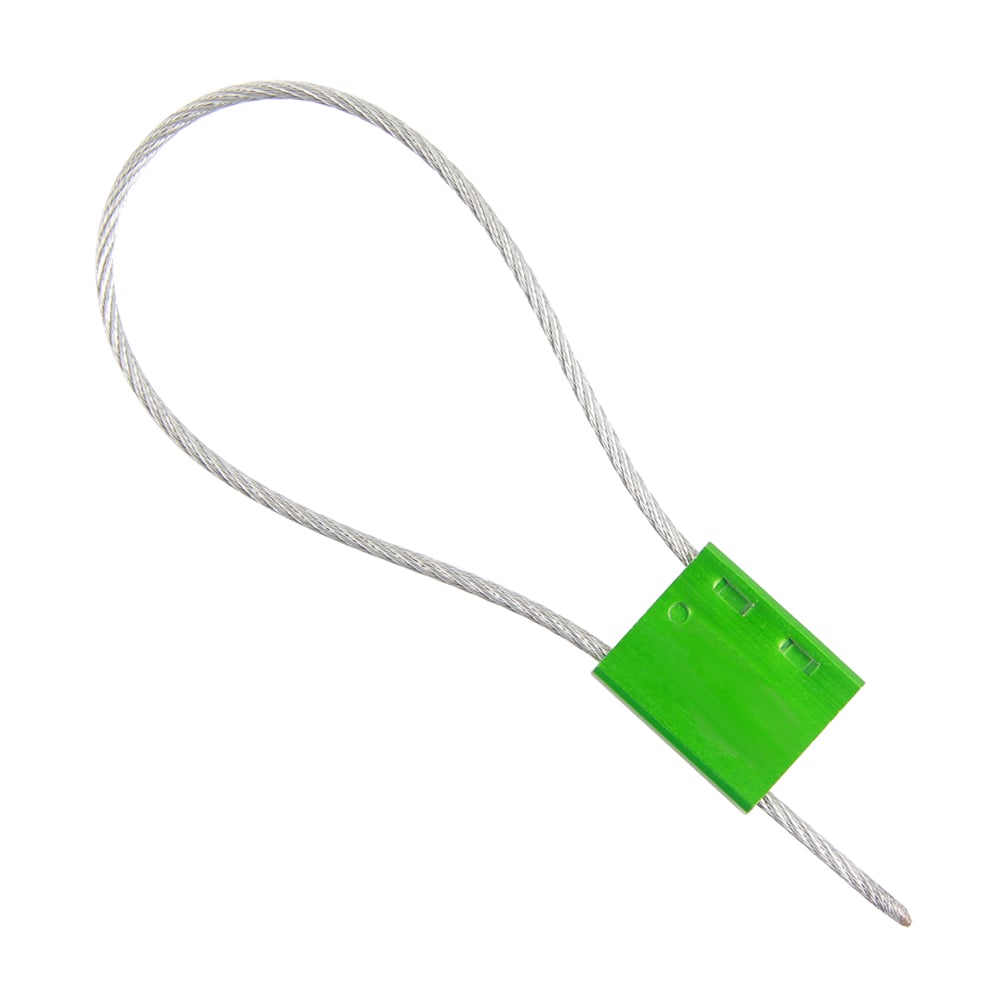
How long should the cable be?
Measure the path the cable must travel through all the closure points, add the slack your process needs, and add enough cable to pass through and lock in the body.
- Standard lengths: MC-K is 230 mm and MC-K2 is 300 mm as standard; both can be made in other lengths.
- Made-to-order lengths: MC-CF, MC-CFB, MC-NCF and MC-NK2 are cut to the length you specify.
- With a pull-through seal, extra length is not a problem – the free end stays visible after locking. With a fixed seal, the length sets the loop size, so measure carefully and confirm on a sample.
Fixed or pull-through: which locking type?
| Feature | Fixed (self-locking) | Pull-through (adjustable) |
|---|---|---|
| How it locks | The free cable end is pushed into the head and gripped at one point | The cable passes one way through the body and is pulled to size |
| Loop size | Set by the cable length | Adjustable – pull it snug against the closure |
| Best for | Repeat closures of the same size, quick fitting | Mixed closures, offset holes, a tight fit |
| Example models | MC-K (230 mm), MC-NK2 | MC-K2, MC-CF, MC-CFB, MC-NCF |
| Removal | Cable cutter | Cable cutter (bolt or cable cutters for MC-K2; heavy-duty cutter for MC-CFB) |
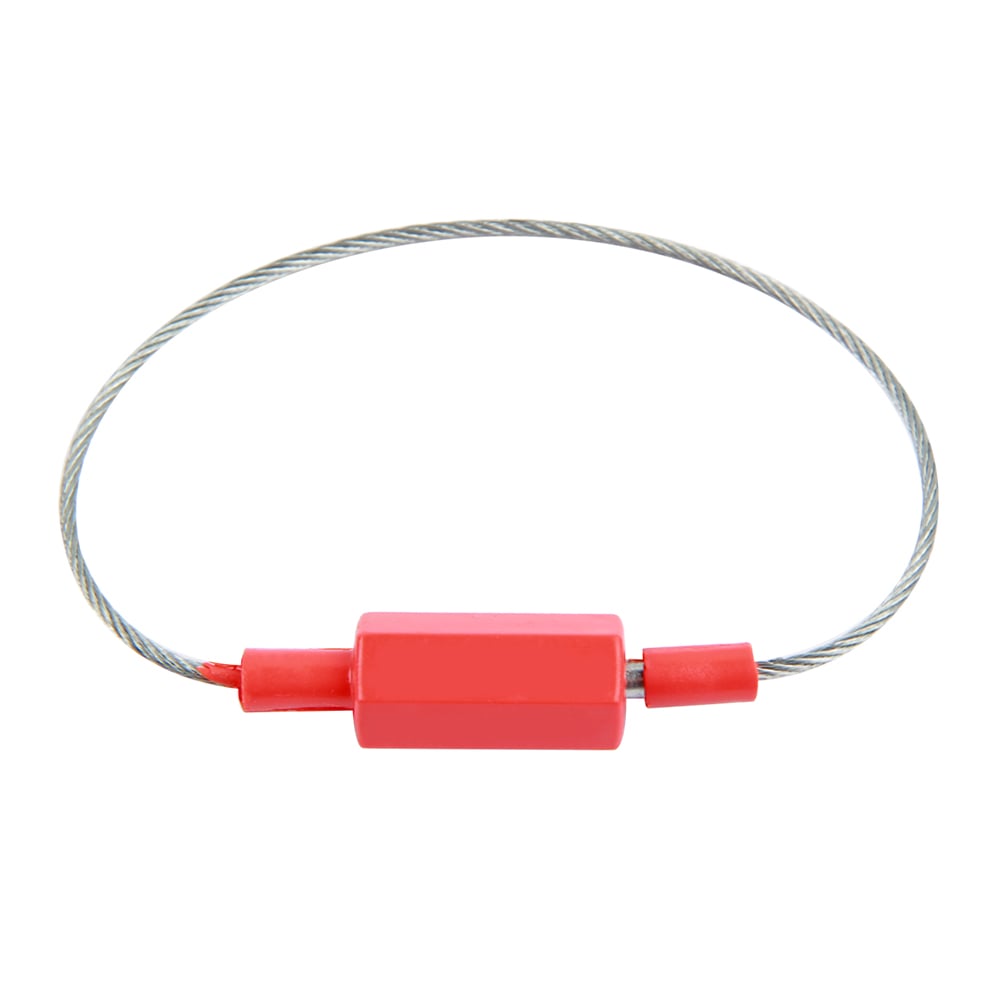
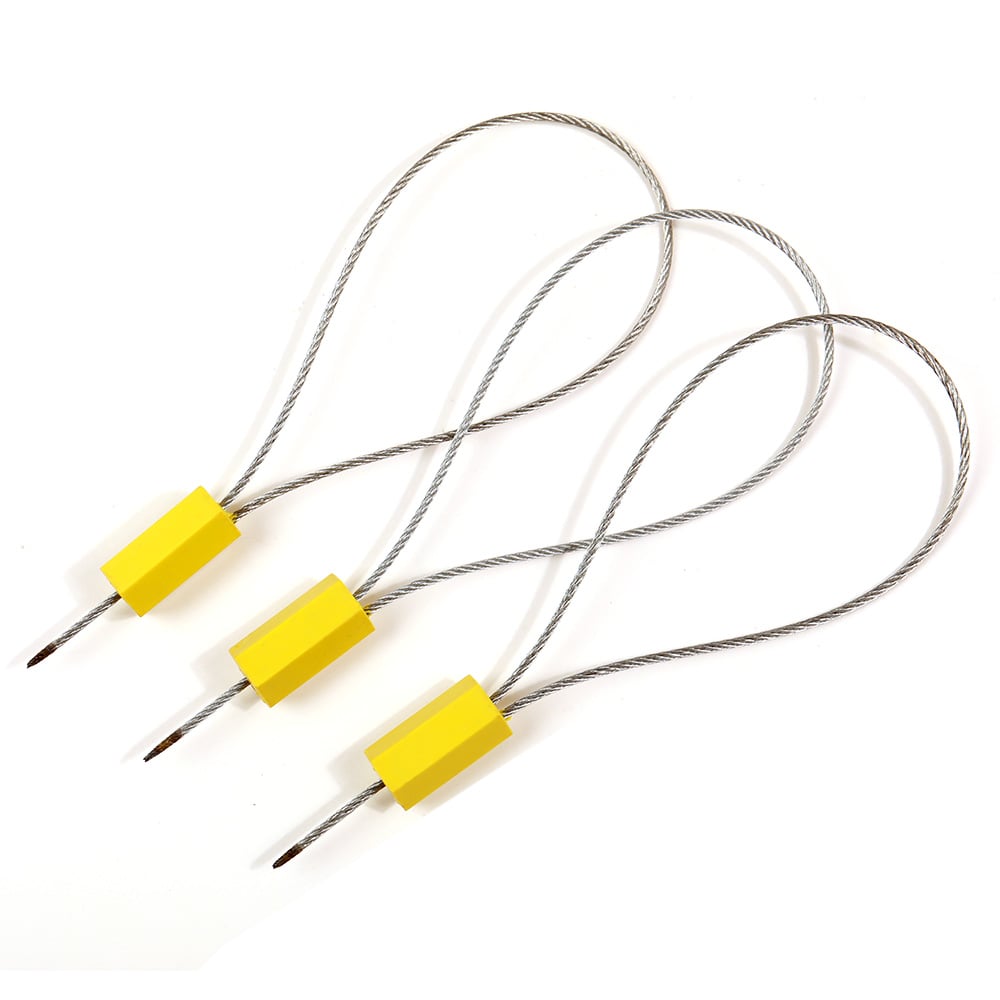
Aluminum body or ABS-coated head?
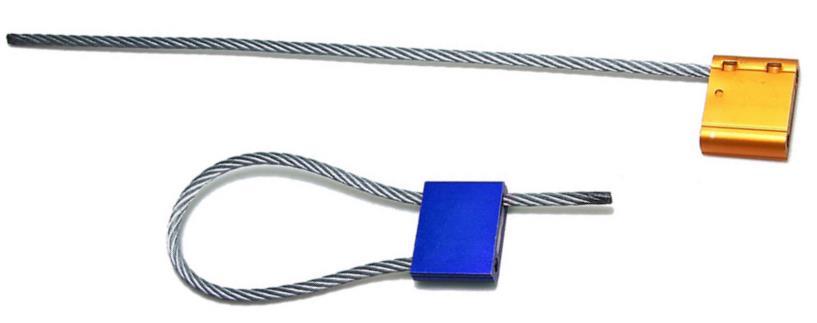
- Aluminum body – MC-CF, MC-CFB and MC-NCF have an aluminum-alloy body with a zinc-alloy die-cast locking device. The catalogue describes them as anti-corrosion and anti-UV. Marking is laser only and appears white – logo, name, serial number and barcode.
- ABS-coated head – MC-K and MC-NK2 have a galvanized low-carbon steel head with an ABS coating; MC-K2 has a zinc head wrapped in ABS. The hexagonal head gives a larger marking face for a logo and serial number, and the coloured ABS makes seals easy to sort by colour.

Six cable seals at a glance
| Model | Cable | Length | Locking | Body / head | Marking | Catalogue MOQ |
|---|---|---|---|---|---|---|
| MC-CF | 1.0, 1.5, 2.0, 2.5 mm | Made to order | Pull-through | Aluminum | White laser | 1,000 pcs |
| MC-CFB | 3.0, 3.5, 4.0, 5.0 mm | Made to order | Pull-through | Aluminum | White laser | 1,000 pcs |
| MC-NCF | 1.5–5.0 mm (8 sizes) | Made to order | Pull-through | Aluminum | White laser | 5,000 pcs |
| MC-K | 1.8 mm | 230 mm standard | Fixed | Steel head, ABS coated | Logo and numbers on the head | 1,000 pcs |
| MC-K2 | 1.8 mm | 300 mm standard | Pull-tight | Zinc head, ABS wrapped | Logo and numbers on the head | 1,000 pcs |
| MC-NK2 | 1.8 mm | Made to order | Fixed | Steel head 12 × 22 mm, ABS coated | Logo and numbers on the head | 1,000 pcs |
See all cable seals. If you are still choosing between seal types, read bolt seal vs cable seal vs padlock seal or plastic vs cable seals.
What should you send your supplier?
- The smallest hole diameter and a photo of the closure.
- The loop path length, or the standard length you want.
- Fixed or pull-through locking.
- Marking: logo, serial number format and any barcode – see how to order custom printed security seals.
- Quantity per order and per year, and the delivery country.
Frequently asked questions
What diameter cable seal should I use?
Use the thickest cable that passes easily through the smallest hole in the closure. Thin 1.0–1.5 mm cable suits bags, cabinets, meters and small eyelets; 1.8–2.5 mm suits most truck and container door handles; 3.0–5.0 mm suits heavier closures.
What is the difference between a fixed and a pull-through cable seal?
A fixed cable seal locks when the free end is pushed into the head, so the loop size is set by the cable length. A pull-through cable seal lets the cable pass one way through the body, so you can pull the loop snug to any size.
Can I order a cable seal in a custom length?
Yes. MC-CF, MC-CFB, MC-NCF and MC-NK2 are made to the length you specify. MC-K (230 mm) and MC-K2 (300 mm) have standard lengths, and other lengths are available on request.
How are cable seals removed?
With a cable cutter. Thick-cable models such as MC-CFB need a heavy-duty cable cutter, and MC-K2 can be removed with bolt or cable cutters. Cable seals are single-use and cannot be refitted.
Can aluminum cable seals be printed in colour?
No. Aluminum cable seal bodies are laser marked only, and the marking appears white. For a printed logo in colour, choose a model with an ABS-coated head such as MC-K, MC-K2 or MC-NK2, and confirm the marking on a sample.
Is a thicker cable seal more secure?
A thicker cable takes more effort and a heavier cutter to remove, but every cable seal is tamper-evident rather than tamper-proof. Choose a diameter that fits the closure and rely on unique serial numbers and records to detect interference.
What is the minimum order for cable seals?
It depends on the model. Catalogue MOQs: MC-CF, MC-CFB, MC-K, MC-K2 and MC-NK2 1,000 pieces; MC-NCF 5,000 pieces.
Ready to choose a cable seal?
Send the smallest hole size, a photo of the closure, the loop length, quantity and marking through our quote form. We will recommend a cable seal model and confirm the marking in the quotation.
Compare seal types →